The company enforces strict management of its three-pronged rule of “not including, not using and not discarding” substances that are harmful to the environment, and is engaged in the promotion of environmental quality alongside product quality.
Changeover to washing liquid with less environmental impact
Washing unit utilizing hydrocarbon-based product
Aimed at environmental risk management, our factories have been involved in preventing contamination from and reducing the use of trichloroethylene to wash products and die. Advanex is pleased to report that a switch from trichloroethylene to a hydrocarbon-based washing liquid has now been completed.
Green partners
Supplier briefings
Advanex holds various briefing sessions with its business partners as it is very important that we know how they also manage environmentally harmful substances to observe the regulation.
Supplier alliances
In order to prevent prohibited substances found in treatment surfaces being used, the company also focuses its attention on plated products. Advanex inspects the plants of surface treatment companies before listing them on our company register.
Emergency procedures
Emergency training
Corporate activities deployed by the Advanex Group are not oblivious to the risk of natural disasters such as floods and earthquakes.
Emergency trainin
All employees participate in emergency training once a year so as to prevent and lessen the impact of a crisis situation. Training involves the prompt extinguishing of fires, evacuation, reporting to the local neighborhood and reporting to administrative authorities.
Entire Group engaged in the environment
The Advanex Group was quick to introduce ISO-14001 and continues to actively implement these standards.
At that time, it was necessary to assemble 32 springs in order to press 16 needles against the retainer with one-way clutch bearings for automobiles. However, the assembly takes a lot of man-hours. The customer was seeking to reduce the man-hours required for the work.
As an operation, since two compression springs of the same shape are assembled per needle, if this push spring is one part connected from the beginning, the assembly can be completed in one operation. Can this not be connected?
The Solution
Development Speed
Advanced Technological Capabilities to Reduce the Number of Cutting-Edge Equipment Components
Since the machine setter which heard the explanation could not be processed at all by the conventional coiling machine, it was decided to change to the NC multi-forming machine. However, because of the structure of the machining machine, machining is not possible by a series of programs, but by devising such as preparing a sub-program halfway, it was possible to make two springs into a set. As a result, 32 assembly steps were reduced by half to 16 steps, and customer ordering management was also simplified. After 10 years of development, the line became the standard product with 24 hours full operation a month.
Specifications
Product
Compression spring
Forming Method
Numerical control machine
Location
Japan
Customer
Bearing manufacturer
Application
Clutch
Market
Automobiles
Leadtime
3weeks
Purpose
To prevent vibration loosening of nuts
Solution
Advanced equipment, prototyping
Customers Benefit
By converting two parts into one part, the man-hour for assembly is reduced by half, and the management cost is also reduced
A switch manufacturer contacted Advanex because the local spring maker they were working with was unable to produce springs that met their design specifications. Advanex offered support, despite the fact that the springs they were using were made by a competitor. The customer had produced specifications for the springs on their own and had them produced by a local spring maker but they were found to be over-stressed and ineffective. They tried to use the Advanex design software on our website but needed the know-how of a specialist, so they contacted the Advanex Customer Support Center.
The Solution
Advanex was able to offer superior service and knowledge to meet a specific challenge. This was achieved by:
Rapid prototyping and testing
Quick and helpful correspondence
Knowledge and technical ability
The customer required a functioning torsion spring for use in a new joystick. The customer requested that Advanex design and develop a spring that would continuously work through the full range of movement required.
To strengthen the customer’s relationship with Advanex, we arranged for their engineers and ours to communicate directly due to the complex nature of the project. After discussing the matter, our engineer at the Koriyama Prototype Center designed a spring that was, in theory, up to the task and sent the drawings to the customer.
Using a numerical control multi-forming machine at the prototype center, they produced a sample with more coils to reduce fluctuations in stress and avoid spring setting and also adjusted the leg angles to meet the customer’s required torque levels and add durability.
In all, five prototypes of the spring were produced. All communication was done via telephone and e-mail exchanges with the customer, who appreciated the quick responses from Advanex. During development of their initial product, the customer then ordered a compression spring, which further demonstrated their faith in Advanex’s capabilities.
An electrical equipment manufacturer made a request to the Advanex group for local procurement and overseas production through its global network. In order to reduce costs, the customer wanted to move his production from Japan to Thailand. As the Advanex Thailand factory is located within 500 meters of the customer’s own factory, they approached the group to see if mass-production was possible in Thailand. The customer also demanded competitive quotes from competitors to ensure they were getting a good price.
The Solution
The transition of production from Japan to the customer’s native Thailand was a smooth process. This was due to:
An effective world-wide network
Consistency and cooperation between the different areas of the group
The knowledge of the Advanex staff
The parts used in digital single-lens reflex cameras are technically demanding, requiring advanced processes to produce. Japan would determine the specifications and pricing but manufacturing would be transferred to Thailand to bring down costs.
In order for this transition to be smooth, it was essential that we had a system for developing prototypes in Japan and transferring the technical details to Thailand.
Advanex also needed to develop and manufacture parts with short lead times and respond quickly to changes in design specifications.
The customer was satisfied with the transitioning of mass production to Thailand. Based on the customer’s requests, the Koriyama Prototype Center and the Niigata production factory worked synergistically to produce samples for the customer’s design department. Improvements were made promptly, giving Advanex an advantage over potential competitors. Once approved, the final designs were submitted and explained to Thailand. Niigata offered continued support to Thailand. Making a trouble-free start to mass-production locally for the customer.
Another advantage the Advanex group had over competitors is that both Niigata and Thailand had the same machinery and technical capabilities, which are employed world-wide, making transfer of production overseas easy.
The customer was an electrical switch manufacturer with a problem during assembly of their product. Solder spatter during the connector assembly process had increased costs to an unacceptable level. The spattered solder rendered defective the expensive electronic chips, (supplied as a connector for an air conditioning unit to the automotive industry), leading to a high rejection rates and a substantial increase in costs.
The Solution
The customer had a significant problem that was costing them dearly. Advanex was able to solve the problem through creative use of their advanced technology. We offered:
An innovative approach
Advanced processes
An inexpensive, easy solution
The customer approached Advanex with the need to develop a connector that would not be damaged from solder spattering during assembly. They needed an easy way of protecting the expensive device from damage.
The creativity of Advanex engineers and with proven technology made it possible to find an ideal solution. To prevent solder spattering during assembly, they found that it would be useful to integrate a cover into the product. The cover should not hinder the soldering process, and removal once the component is installed needed to be simple with no risk of damage to the rest of the device.
To do this, the cover needed to be secure but insubstantial enough to allow easy removal. The main factor was the material thickness of the joint portion.
An ideal thickness could not be calculated but the engineer was able to achieve optimal performance through his best judgement.
To manufacture the product, Advanex used our double insert molding technology. The approach to solving this problem has been and object lesson to Advanex staff that demonstrates the importance of creativity in finding a solution.
Advanex is proud to have developed a product that is still vital to this customer 15 years later.
The customer, a leading producer of mobile phone antennas in Japan, approached Advanex with a sketch of a small piece of folded wire that would act as an internal antenna in a mobile phone. At the time (2001), mobile phone antennas had a ‘pop-up’ design, but if this product could be made to work successfully, the design of mobile phones would be greatly improved, while making them smaller. To create a functional internal antenna the customer believed it should be made from a small folded wire spring housed in the body of the phone.
The Solution
From wire spring to a flat spring insert molding, the change in thinking led to huge success. Advanex was able to offer:
Innovative solutions to new problems
Unrivalled expertise in metal manufacturing methods
Resources to meet a huge production demand
The customer requested that Advanex develop the smallest internal antenna possible, with a high receiving capacity. Advanex developed this antenna utilizing a spiral shaped spring of excellent quality, which was a world first.
In order to get a spiral spring to fit into the phone housing, Advanex first made a prototype resin case. However, the customer could not get a stable signal because the pitch of the spring was affected by the phone’s vibrations. Advanex brainstormed the problem and an insert molding engineer proposed using a press processing method that utilized the spiral shape to get a favorable reception. This lateral thinking was the reason for Advanex’s success.
Based on our sketch the customer cut and bonded copper foil onto a handmade resin prototype and achieved the required reception with the Advanex design. Working with the customer, Advanex then developed trial precision flat springs integrated into an intricate plastic molding. Using this technique and our automated insert molding process, Advanex was able to give the customer a product that gave both good reception characteristics and ease of assembly into the mobile phone.
The change in design from a wire spring to a flat spring insert molding ensured high productivity for both Advanex and the customer. It was a world-first product and gained the customer a reputation for innovation in the industry.
The customer was a medical equipment manufacturer that had received reports of accidents occurring with their new product – the lens cover on their halogen lamp had detached due to the fastener becoming loose under heat, creating a potential hazard. Medical institutions demanded the product be improved and the customer had to work quickly to calm the claims against their product as soon as possible.
The expertise of the technicians at the Koriyama Prototype Center
Keeping down the cost of the solution
Meeting production requirements
The customer’s product was used regularly in medical institutions, so it was impossible to collect and repair them all efficiently. They would have to visit all nationwide delivery destinations as soon as possible and replace the defective part to prevent accidents from the lens cover falling off.
It was essential that a simple solution be found so that the customer’s representative could make the repairs easily by themselves without having to modify the units—by making a hole for example.
In addition, because of the number of units it was essential to minimize the cost of this solution.
Due to the urgency of the situation, an Advanex representative took the customer to Koriyama Prototype Center. The most experienced of our technical staff made a trial spring by hand right away, and made a drawing based on the trial spring under the assumption that it would be mass-produced on our multi-forming machine.
After only two trials, the customer was satisfied and Advanex was able to supply the ideal product in just three weeks.
With only one month until a model change, the customer could not find an acceptable solution to their problem – which was that his engineer was having great difficulty designing a spring with sufficient load for a glove box lid and pressure was building as the deadline approached. An Advanex representative brought the engineer and the product to the Koriyama Prototype Center to help solve the problem.
The Solution
For this difficult problem, Advanex was able to meet the customer’s deadline through:
Rapid prototyping and testing at the Koriyama Prototype Center
Excellent support and communication
Knowledge and advanced methodology
The customer’s problem was that if the spring load was too high, the glove box lid would not open; too low, and vibrations from the car would cause the lid to open. The engineer tested many spring variations but could not find an optimal solution.
With the deadline quickly approaching, the engineer made a drawing of a spring and sent it to the Koriyama Prototype Center. Based on this drawing, and with the advantages of numerical control machines and specialists, samples were prepared in increments of 1 newton around the engineer’s calculated optimal load.
The customer’s engineer then visited this facility and was presented with the spring samples, whereby he fitted them to the glove box and lid assembly. Choosing the best spring, the engineer returned to the customer’s site and proved that the spring passed the durability tests.
However, during assembly, the engineer discovered a possible risk of injury due to the sharp end of the spring. The engineer redesigned the spring to remove this risk and sent the drawings back to Advanex. The spring was redesigned, further improved and finally, after several trials, the ideal spring was supplied within the customer’s one month deadline.
A manufacturer of plant equipment based in Hokuriku needed to incorporate springs into a partition they were making for the air conditioning control unit of a clean room. Initially they purchased standard springs from a wholesale supplier made from music wire. They tried several variations but could not make their product work successfully. This led them to approach Advanex via the web.
The Solution
For a customer with no prior knowledge of springs, Advanex was able to provide an ideal product with a prompt and helpful response. We offered:
Custom design and development from initial inquiry to end product
Rapid design and development
Quick delivery
The customer commissioned Advanex to design and manufacture springs suitable for their product, which would be used in clean rooms.
The original springs used by the customer were made from music wire and were thus susceptible to rusting, making them unsuitable for a clean room environment. They requested that the springs from Advanex be manufactured from stainless steel that would retain the original functionality of the previous materials.
The customer had no experience designing springs so they consulted Advanex by telephone and e-mail explaining that by using stainless steel instead of the music wire they were breaking new ground, so we would need to do a redesign to meet their requirements.
A design specification was provided and trials begun. Three trial sets were carried out to reach a suitable solution for their application and the final product was delivered just 25 days after their initial contact with Advanex.

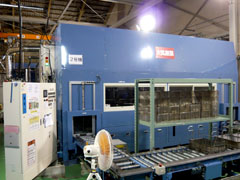 Washing unit utilizing hydrocarbon-based product
 Supplier briefings
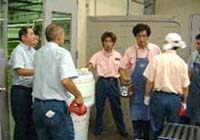 Emergency trainin